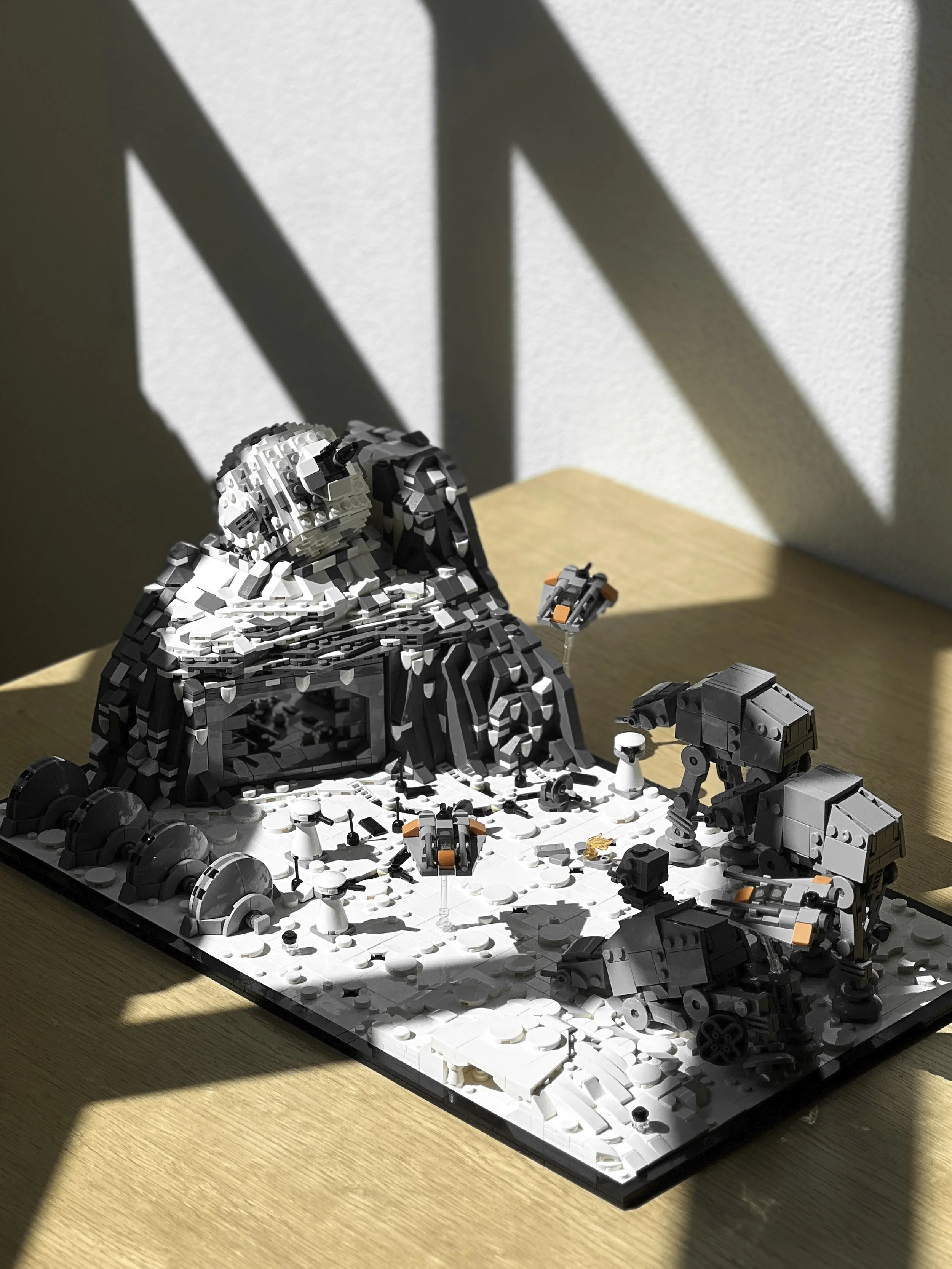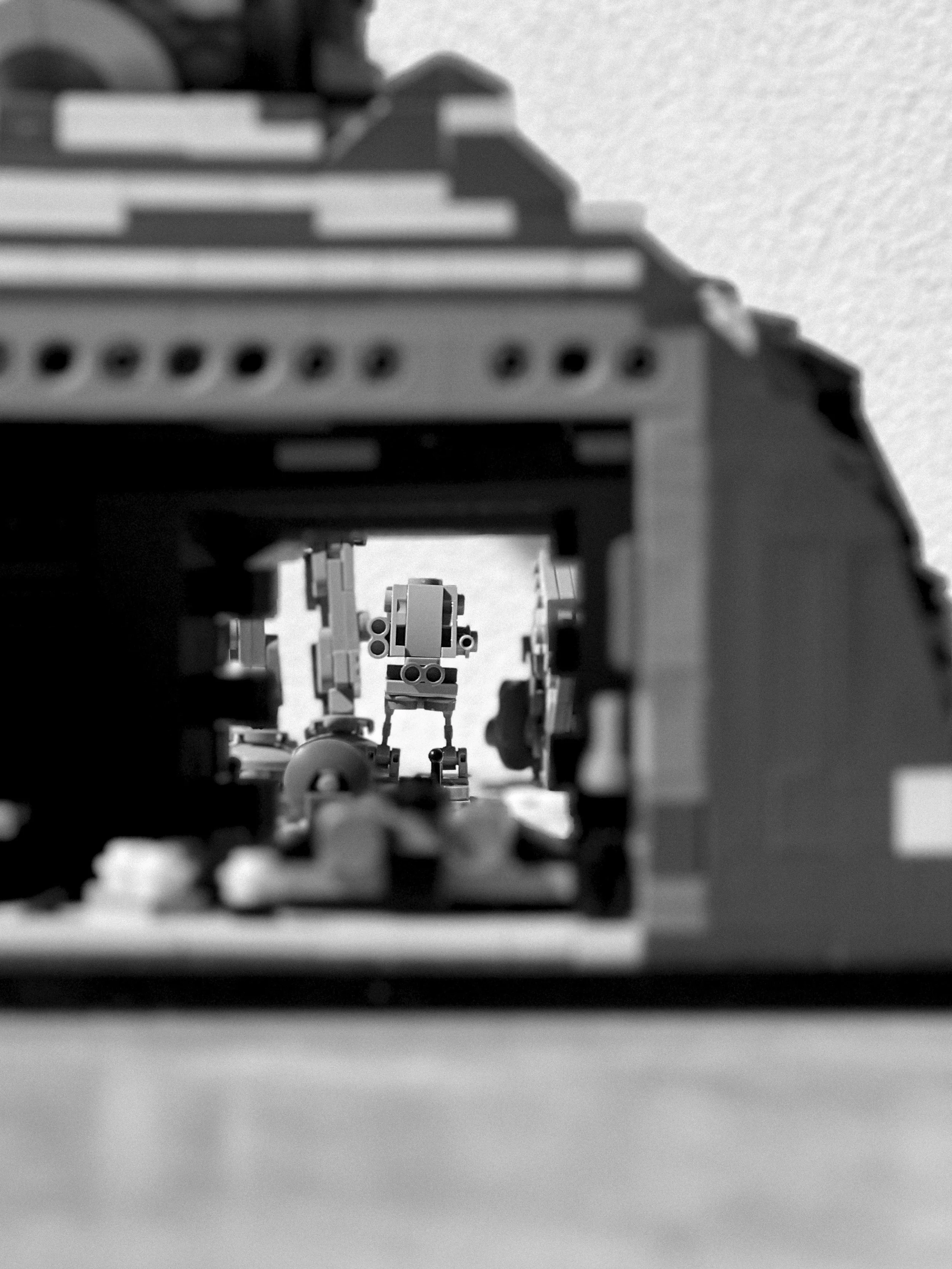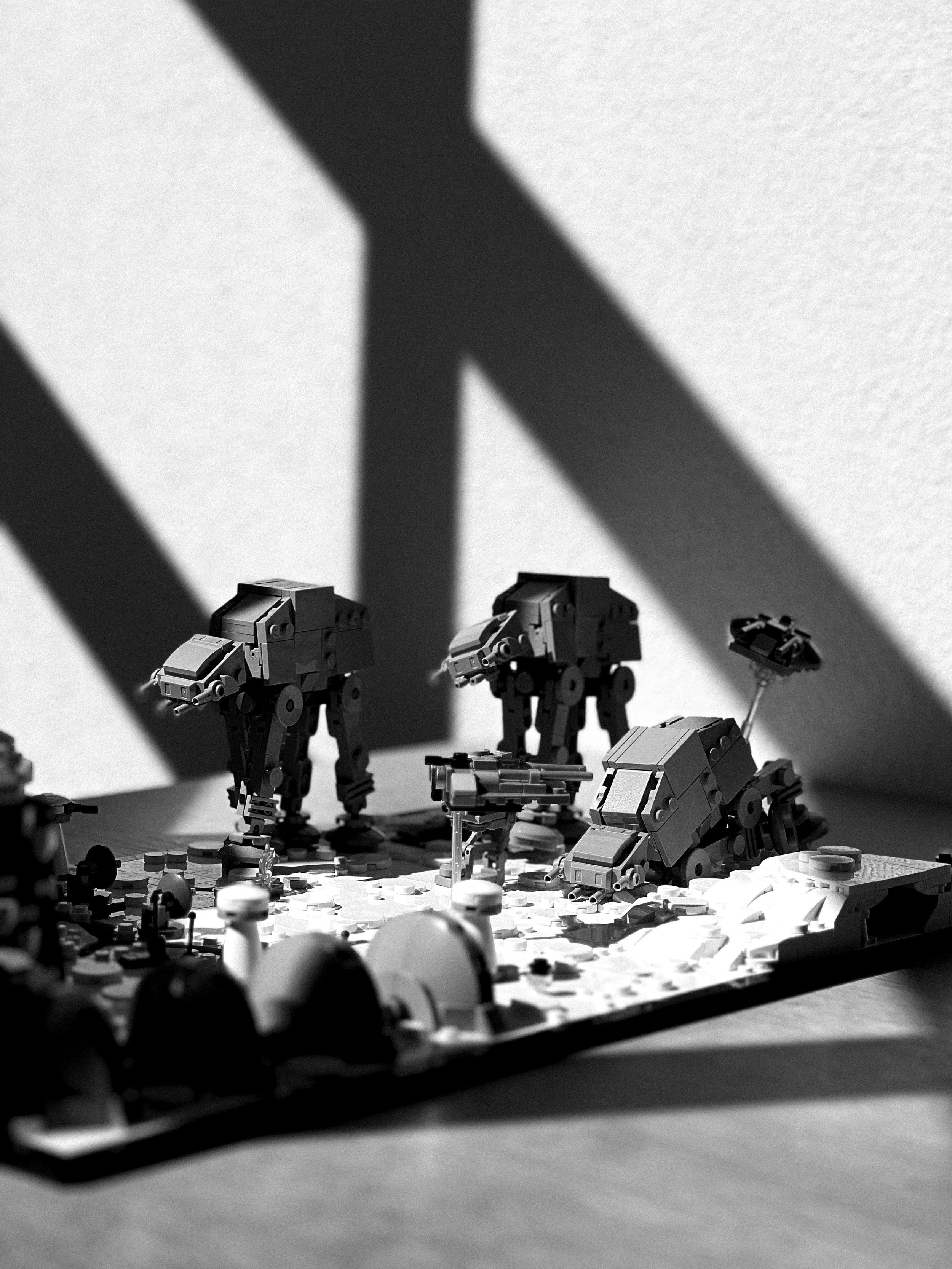
There are films we remember as stories, and there are films we remember as images. The Empire Strikes Back belongs firmly to the latter. A vast white landscape. Dark mechanical silhouettes appearing on the horizon. A rebel base disappearing into the ice. Four-legged machines advancing with an almost prehistoric weight. Even removed from dialogue, music and context, these images remain remarkably easy to recognise. More than four decades later, three Modbrix sets manage to trigger much of that memory using something considerably less cinematic: 2,990 small pieces of plastic. Individually, Attack on the Ice Planet, Rebel Base on the Ice Planet and Shield Generator + Monster Cave are complete little scenes. Together, however, they become something much more interesting. The landscape expands, relationships between objects begin to appear and separate models suddenly read as one continuous frozen world. This modularity may be the cleverest decision behind the entire series.
A miniature of a miniature
There is something wonderfully appropriate about recreating Hoth at microscale. The original Battle of Hoth was itself an extraordinary exercise in manipulating scale. Industrial Light & Magic combined miniature vehicles, stop-motion animation and enormous painted backgrounds to convince an audience that towering machines were crossing an endless frozen battlefield. The AT-ATs were not digital objects obeying simulated physics. They were physical models, moved incrementally and photographed frame by frame. For parts of the battle, the animated models were photographed directly against vast painted representations of Hoth. The illusion worked because artists understood that scale is not necessarily created by size. It is created by proportion, movement, composition and the information our brains already know how to complete.
Modbrix performs a strangely similar trick here. A handful of white slopes becomes a snow-covered ridge. A tiny arrangement of grey pieces becomes military machinery. Walkers assembled from remarkably few elements immediately acquire enormous imaginary mass. Small trenches, vehicles and structures suggest a battlefield extending far beyond the physical limits of the display. The models are tiny. The scene they evoke is not.
Recognition without a logo
There is another interesting detail: none of this carries an official Star Wars licence. And yet almost nothing about the scene feels anonymous. This raises an interesting question about what actually creates an emotional connection to a franchise. Apparently it is not necessarily a logo on the box. Nor does it require printed character torsos, recognisable minifigure faces or a sheet of branded stickers. Sometimes four legs in the right proportions are enough. Modbrix understands the visual vocabulary of the source material remarkably well. The shield generator, the trenches, the walkers, the hangar-like rebel architecture and the almost complete absence of colour communicate Hoth with extraordinary efficiency. They do not reproduce every detail. They reproduce the details our memory considers important.
That distinction is crucial. Good microscale design is an exercise in editing. There are too few pieces available to describe everything, so the designer has to decide which shapes carry identity and which can disappear. At its best, this trilogy of sets demonstrates exactly that kind of restraint. It feels less like imitation and more like visual shorthand.
Three boxes, one landscape
Each set has enough character to exist independently. The rebel base provides architecture and interior depth. The battlefield brings movement and instantly recognisable mechanical silhouettes. The third set expands the landscape with the shield generator, terrain and monster cave. But I would find it difficult to go back to displaying them separately. Once connected, the boundaries between products become almost irrelevant. What were three purchases become one composition. The eye travels from the base across the landscape towards the battlefield, discovering small events along the way. This gives the finished display something many individual brick sets struggle to achieve: context. An AT-AT standing on a black base is a model. An AT-AT approaching a rebel installation through a landscape populated with smaller vehicles and defensive structures is a story. That transformation is the real achievement here.
For the sorting kind
The building experience itself is rather more old-school. This is Modbrix through the BlueBrixx Special school of thought. The brick quality is perfectly respectable, but presentation is utilitarian. There is no luxurious box art waiting to be admired, no printed instruction book to place on the coffee table and no carefully numbered sequence of bags turning several thousand pieces into conveniently portioned evenings. You receive bricks. You receive digital instructions. The rest is largely your problem. I rather like that.
Building all three sets creates an impressive amount of plastic across the table, but it also gives the pedant in me an excuse to indulge in a ritual I genuinely enjoy: sorting everything beforehand. Shapes together. Colours together. Small pieces given their own territories. By the time construction is underway, something close to muscle memory develops. A 1x2 plate is no longer something I need to search for. My hand simply knows where it lives. It is not the most luxurious building experience. It may, however, be one of the more honest ones.
Not everything survives the reduction
Microscale inevitably involves compromise, and a few of those compromises are more successful than others. The AT-AT walkers are visually excellent but structurally rather delicate. The connection between feet and legs in particular feels sufficiently fragile to qualify as a predetermined breaking point. They reward careful positioning rather than enthusiastic handling. The spherical laser installation is another weaker moment. Against the remarkably sophisticated terrain and architecture surrounding it, its exposed studs and simplified geometry feel unusually rudimentary. Microscale requires abstraction, certainly, but here the abstraction feels one step less resolved than elsewhere. The rear of the rebel base is also unapologetically functional. Its open construction allows access to the interior and Technic bricks provide understandable structural support, but viewed from behind it loses much of the visual magic present from almost every other angle. None of these issues significantly damages the display. They simply reveal where the illusion ends. Every film set has a side the camera was never supposed to see.
The memory does the rendering
What surprises me most about the completed diorama is how strongly other people respond to it. Visitors notice it. They approach it. They begin identifying scenes and objects. People who would normally give one of my brick models a polite glance seem to spend considerably longer examining this one. Part of that reaction undoubtedly belongs to Star Wars. Hoth carries an enormous amount of cultural memory and recognition happens almost instantaneously. But I don't think nostalgia deserves all the credit. Modbrix has given that nostalgia somewhere convincing to land.
The designers understood that the Battle of Hoth was never memorable because of a single vehicle or character. It was memorable because of scale: tiny rebels against enormous machines, black technology against endless white terrain, movement across emptiness. By allowing three sets to merge into one landscape, they recreate precisely that relationship. There is a pleasing circularity to it. In 1980, filmmakers used miniature models and painted scenery to make a fictional world feel enormous. Today, designers reduce that enormous fictional world back into another collection of miniatures. And somehow, the illusion survives both journeys.
No licence. No minifigures. No logo required. Just a handful of carefully chosen shapes and forty-six years of collective memory doing the rest. Perhaps that is why this display works so well. Modbrix did not try to put Star Wars into bricks. They understood which bricks would make us put Star Wars back into them.