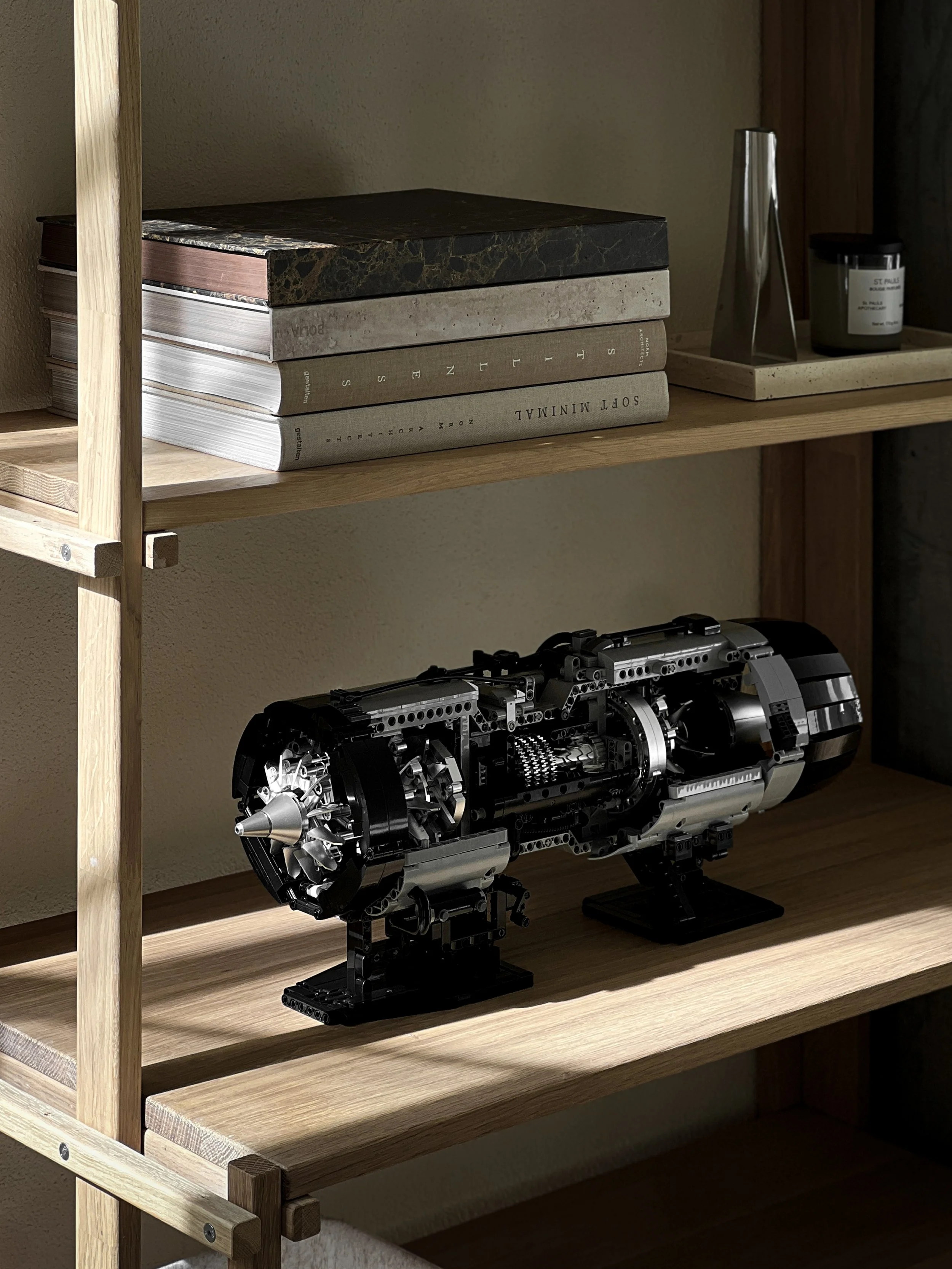
There is a particular kind of pleasure in knowing exactly what you are getting. After several Nifeliz builds, the brand has established itself as something of a safe place in my collection. Not safe in the sense of being dull or predictable, but reassuringly dependable. The pieces are excellent. The instructions are beautifully produced and almost impossible to misunderstand. Nothing is missing. Nothing requires improvisation. Everything arrives packaged with a level of visual consideration that suggests someone cared about the experience long before the first bag was opened.
When I want a genuine battle with bricks, there are other manufacturers I can turn to. When I want to put on a series, clear the table and simply enjoy building for a few hours, I increasingly find myself reaching for Nifeliz. That distinction matters. Nifeliz understands its audience remarkably well. Perhaps very well. Its packaging, manuals and extensive library of product imagery are among the most visually accomplished in the alternative brick market. Renderings, compositing and what appears to be the occasional touch of AI come together into an unusually coherent visual universe. With my background in graphic design, I find it difficult not to appreciate the effort.
There is even something rather charming about how little ambiguity remains about the intended customer. Nifeliz product imagery has a habit of placing its models alongside almost archetypal inhabitants of beautifully curated adult interiors. Subtle it is not. But the message is clear: these are objects intended to survive the journey from building table to living room. Which brings us to a jet engine.
Controlled complexity
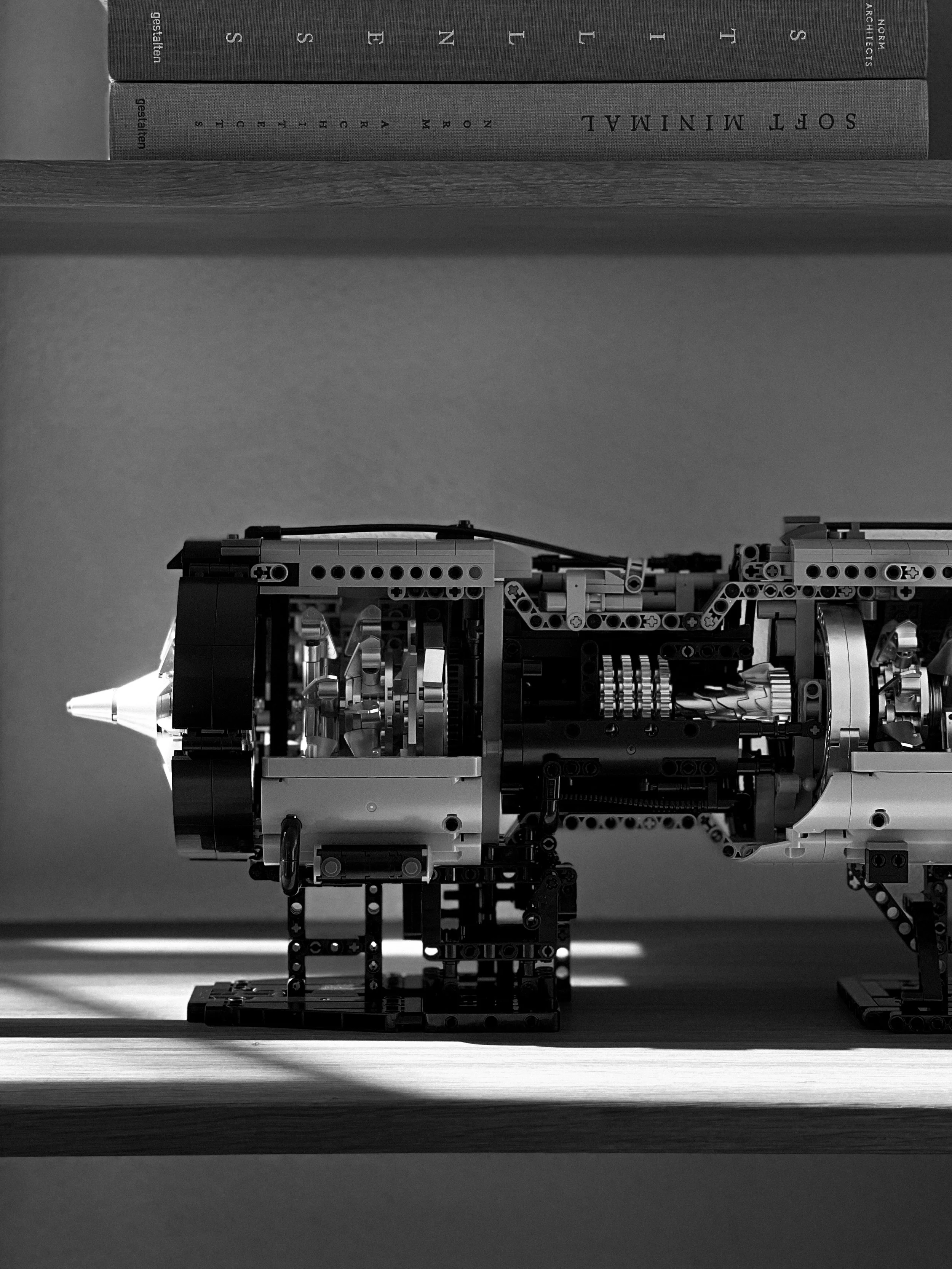
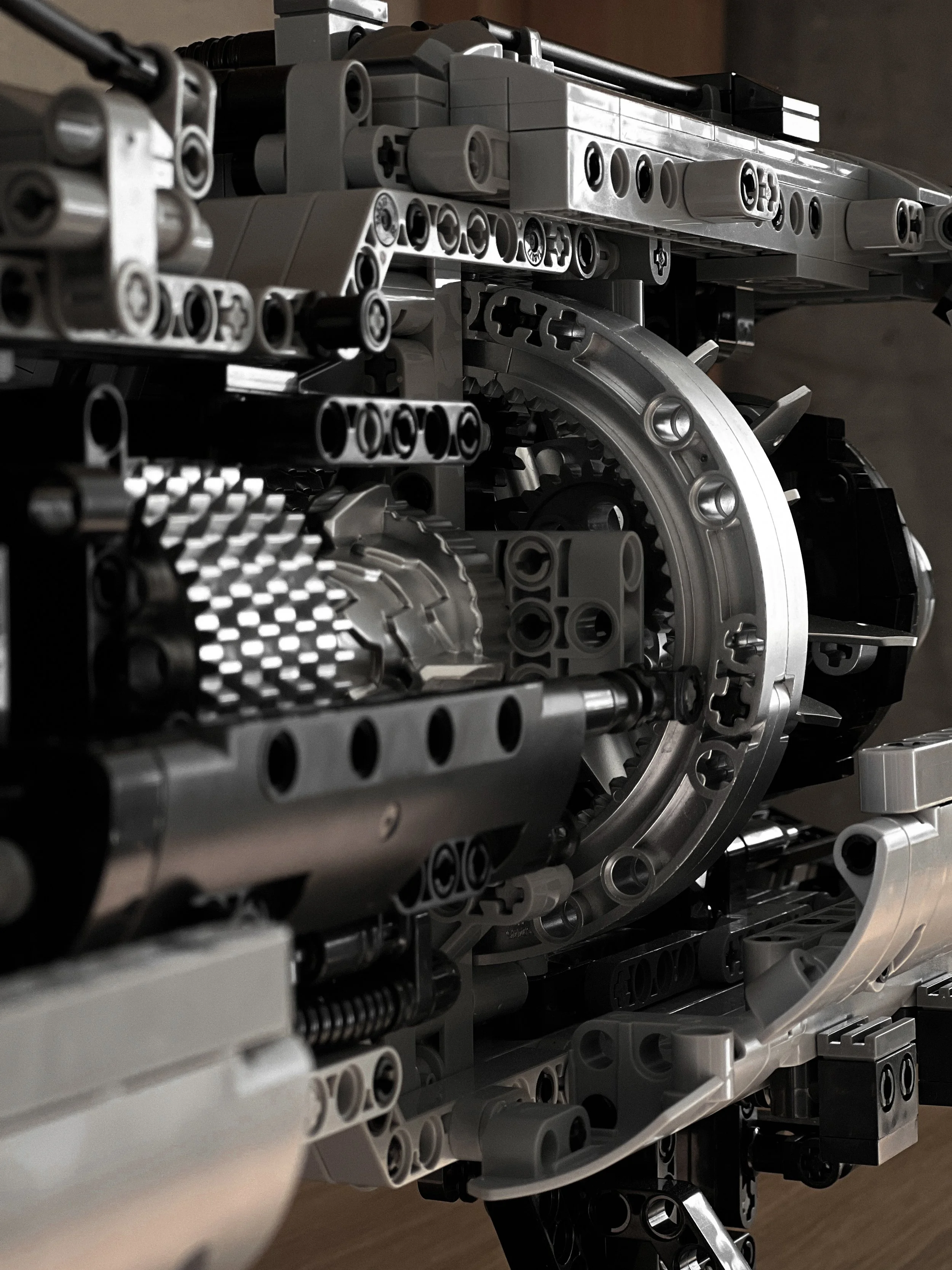
At first glance, the Turbofan Engine appears intimidating. Gears disappear behind structural frames. Axles cross through mechanical assemblies. Large metallic rings surround turbine stages, while exposed Technic structures suggest the kind of model where one misplaced connection might reveal itself 200 steps later. It isn't. The construction develops with almost suspicious ease. Each assembly is clearly resolved before the next is introduced, and despite the mechanical density I never felt the need to give the model my undivided attention. I comfortably watched a series while building it.
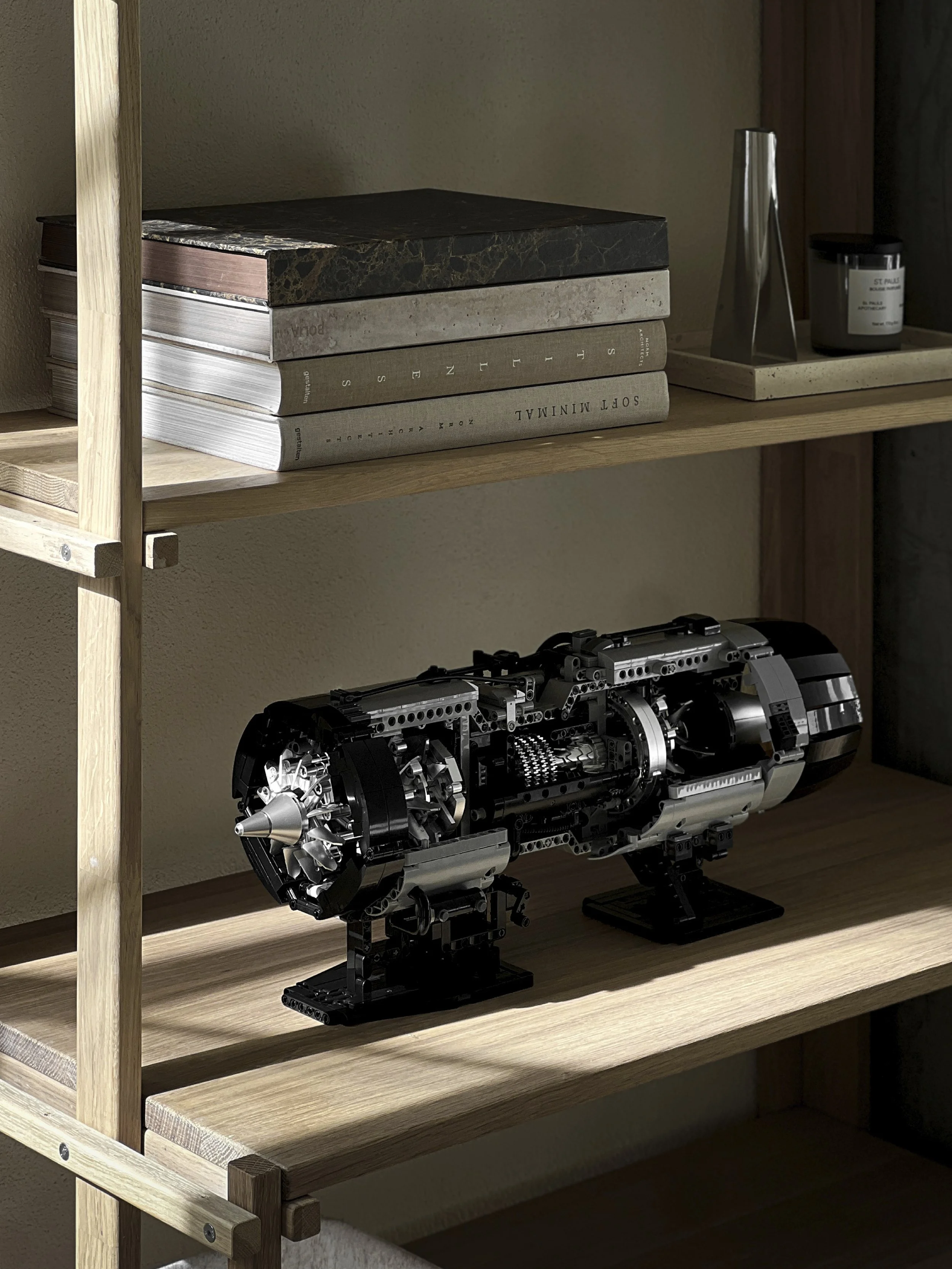
For some builders, that may sound like criticism. For this model, I think it is part of the appeal. The complexity is visual rather than procedural. Nifeliz lets you assemble something that looks considerably more intimidating than it actually is. Roughly four relaxed hours later, there is a surprisingly substantial piece of machinery sitting on the table. Along the way, the metallic elements repeatedly steal the show. The drum-lacquered finish works particularly well across the large curved surfaces, turbine components and enormous gears. Light moves across them beautifully, giving the otherwise restrained black and silver construction an almost machined quality.
A little too much colour
Then there are the pins. Red axles and blue pins appear throughout the construction, and they appear in considerable numbers. I understand the logic. Colour coding makes Technic construction easier to navigate and reduces mistakes. But this particular model is sufficiently straightforward that I question whether it needs quite so much assistance, especially when its exposed mechanical architecture is such an important part of the finished design. Black, graphite and metallic silver create an excellent industrial palette. Bright blue and red inevitably interrupt it.
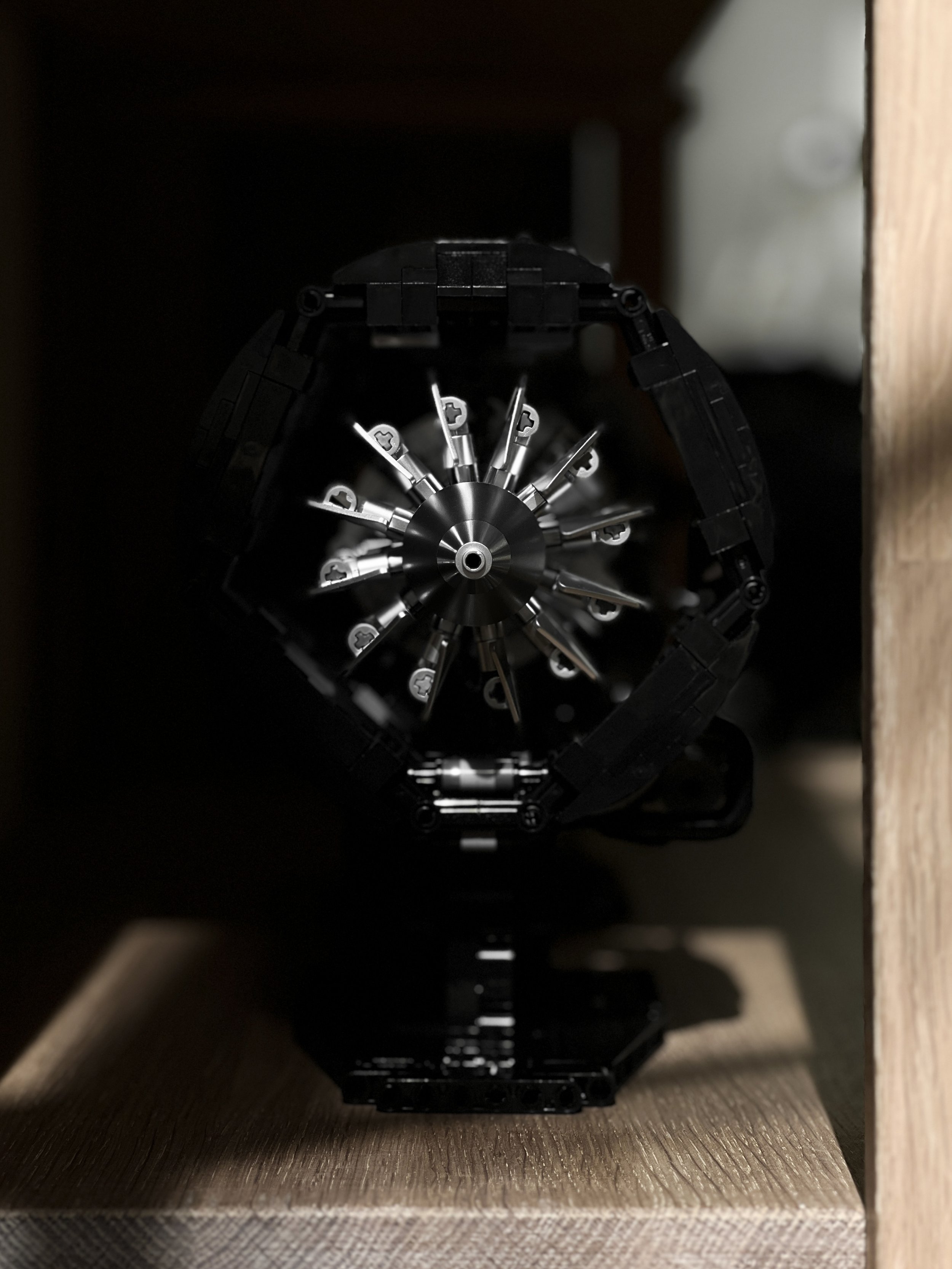
So I cheated. Or, depending on your philosophy, improved it. A visit to my own parts collection replaced many of the visible blue pins and red axles with black and grey alternatives. The engine shown in these photographs is therefore not entirely stock, but the change demonstrates just how strong the underlying design is when allowed to remain visually quiet. I would love to see Nifeliz offer that restraint straight from the box in future display-oriented mechanical sets.
The satisfying part
Having previously built the Nifeliz Tourbillon, I approached the mechanical function with relatively modest expectations. That turned out to be unnecessary. From the moment the first connected mechanisms began moving until the completed engine sat on its stands, the drivetrain behaved beautifully. Turning the mechanism sends the gears and turbine sections into motion with a smoothness that is immensely satisfying. No binding, no alarming resistance, no sense that the structure is fighting its own mechanism. It simply moves, and moves extraordinarily well.
There is something almost therapeutic about watching a complicated collection of gears, shafts and turbine stages quietly agree with one another. The structure surrounding them is equally convincing. The completed model feels extremely rigid and substantial, allowing you to operate it without the nervous two-handed support that some functional brick models demand. Credit to the designer here. Mechanical models can impress through complexity alone. Making that complexity behave effortlessly is much harder.
An engine in the living room
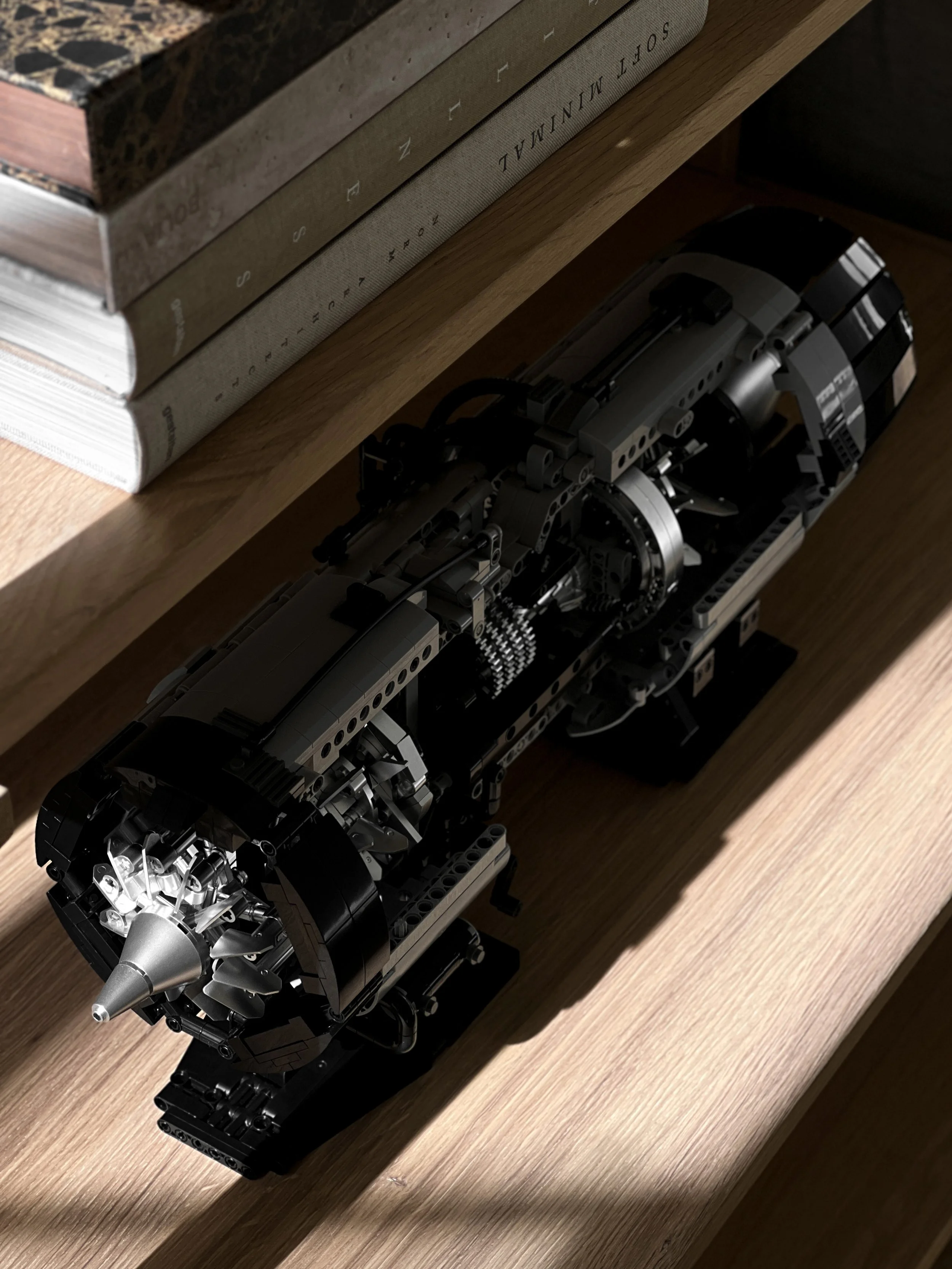
Once finished, the Turbofan Engine is larger than its piece count might suggest. Its semi-exposed construction is particularly successful. Enough of the outer form remains to make the object immediately readable as an aircraft engine, while large sections have been deliberately removed to expose the machinery within. It sits somewhere between engineering model, cutaway illustration and industrial sculpture.
And this is where my relationship with it becomes slightly complicated. I admire it. I enjoyed building it enormously. I keep turning the mechanism. Whether an exposed aircraft turbine will earn permanent residency in our living room is another question entirely. I am, after all, not the only person living there. It has already been politely observed that humanity has produced more conventionally beautiful subjects than turbofan engines. Fair enough. That is hardly Nifeliz's fault.
What Nifeliz promised was a substantial, functional mechanical model at a moderate price. What I received was several hours of completely frustration-free building, excellent materials, beautiful metallic surfaces, a genuinely satisfying mechanism and a finished object with far more presence than I expected. It also reinforced something I have increasingly come to associate with the brand. Nifeliz may not always give me the hardest builds in my collection. That is not necessarily what I want from them. They give me confidence: confidence that the parts will be there, that they will fit, that the instructions will make sense, that the packaging will feel considered, and that a complicated-looking object can simply be enjoyed without turning an evening of building into an exercise in troubleshooting.
There is considerable value in that. The Turbofan Engine looks like engineering. It builds like relaxation. And sometimes, that is exactly what I want.