Holding Pattern
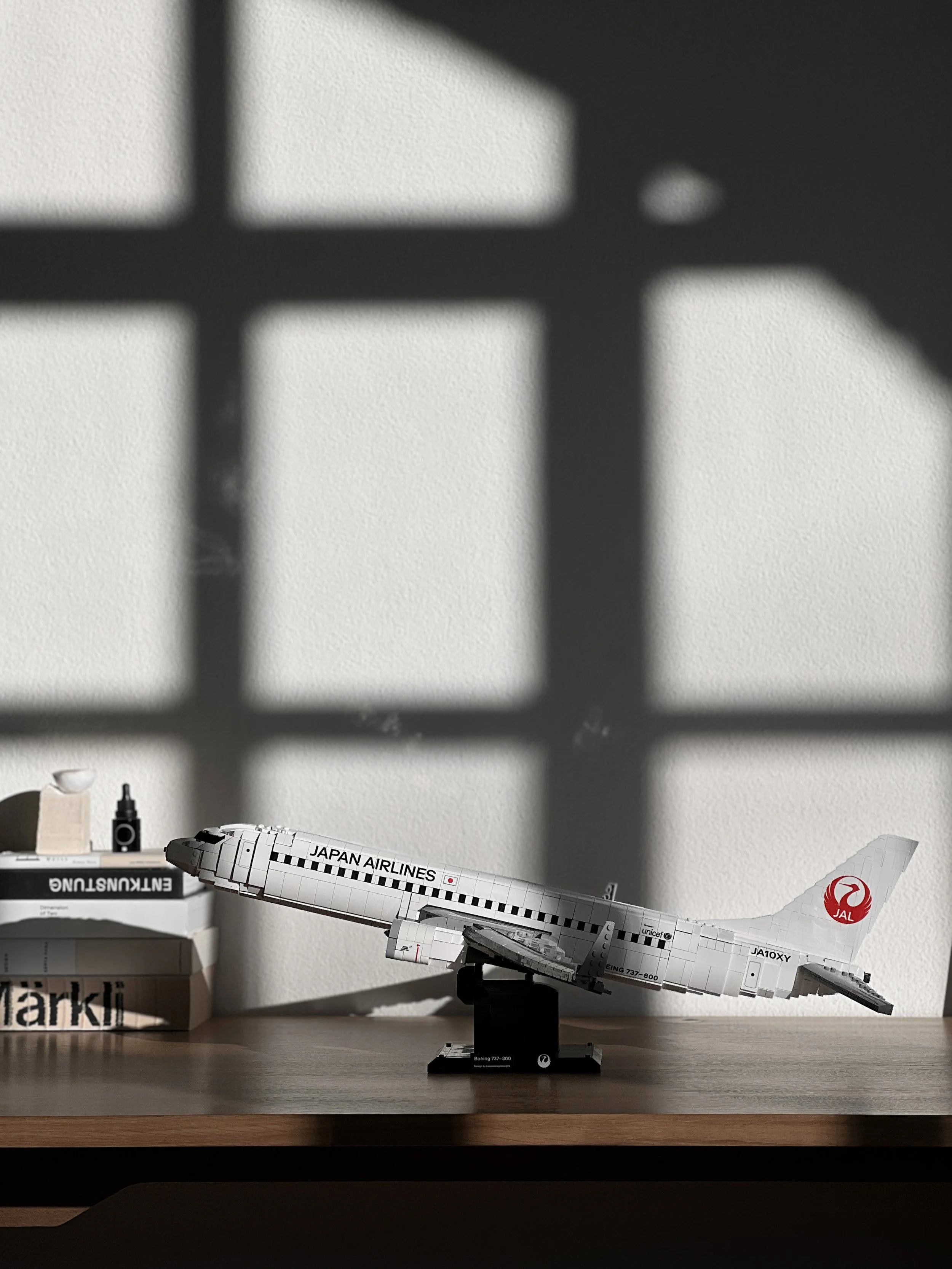
A Boeing 737-800, 2,673 pieces and the quiet pleasure of building something that refuses to make itself easy.
I am afraid of flying. Quite profoundly, in fact. This has never stopped me from being fascinated by aviation. There is an obvious contradiction in this. The moment an aircraft leaves the ground, my appreciation for engineering tends to give way to a considerably less rational response. Yet from a safe distance, I find these machines extraordinarily beautiful. There is something compelling about their scale and precision, about the way enormous technical complexity is resolved into such a restrained visual language. A fuselage, wings, engines, tail. Very little appears superfluous. Even standing still, an aircraft seems shaped by movement.
Perhaps that is why building one appealed to me. At a table, the relationship changes completely. An object I would normally experience with a certain degree of apprehension can be slowed down, separated into parts and understood through my hands. The sweep of a wing is no longer something glimpsed through an airport window, but a sequence of small geometric decisions. The length of the fuselage becomes tangible. Engines, windows and control surfaces gradually find their position in relation to one another. For once, aviation happens at a scale I can comfortably control.
The Boeing 737-800 makes an especially interesting subject because it is so familiar. It lacks the theatre of Concorde or the improbable scale of an A380. For millions of people, this is simply what an aeroplane looks like, a silhouette absorbed so completely into our visual memory that its qualities are easy to overlook. Building it made me look more carefully. I began to notice the tension between its long, almost graphic fuselage and the thin planes of its wings, the visual weight of the engines beneath them and the dark rhythm of windows running through an otherwise remarkably quiet form.
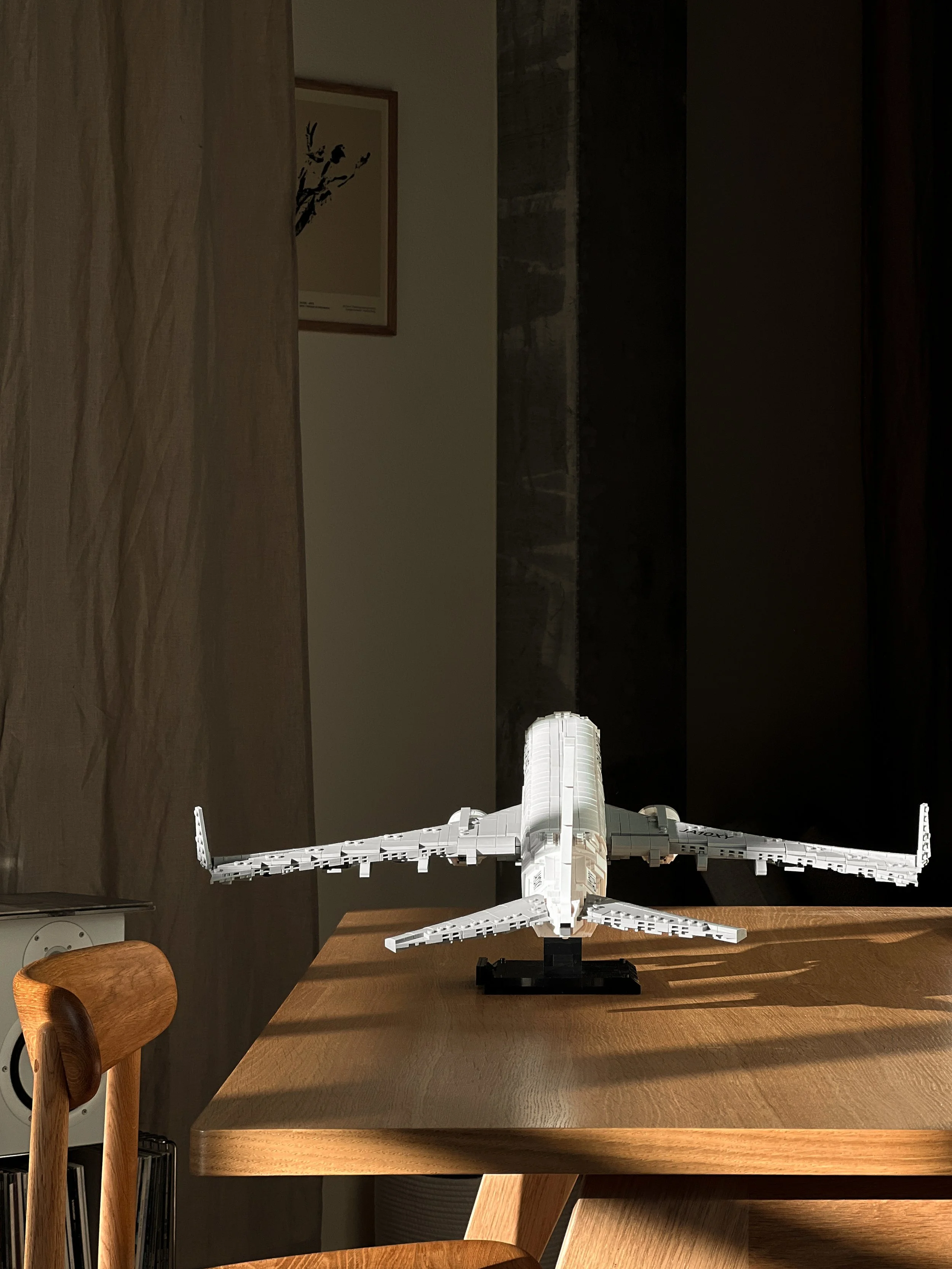
A controlled distance
This particular interpretation consists of 2,673 pieces and was created by BespokeLegoDesigns, an independent designer with a clear affinity for aviation. Cubertime offers the design as a licensed complete set, removing what would otherwise be the rather less romantic task of sourcing thousands of individual elements. There is something appealingly simple about that proposition: a box arrives, you clear the table, and an aircraft slowly begins to emerge. Importantly, that convenience does not erase the character of the original MOC. This still feels like an independent design, specific in its priorities and occasionally unconventional, rather than something polished into anonymity on its way into a box.
The parts are packed pragmatically rather than divided into a long succession of numbered stages, so the first encounter is not really with the 737 at all, but with its material: hundreds of plates, slopes, wedges and small elements waiting to be understood. I rather enjoy this. Over time, sorting has become part of the ritual for me, a quiet transition between opening a box and actually making something. I use felt trays in different sizes, partly because they soften the incessant sound of plastic, but mostly because they lend the process a certain calm. Gradually, an anonymous mass of pieces develops a geography, until your hands begin to find things almost before you consciously start looking for them.
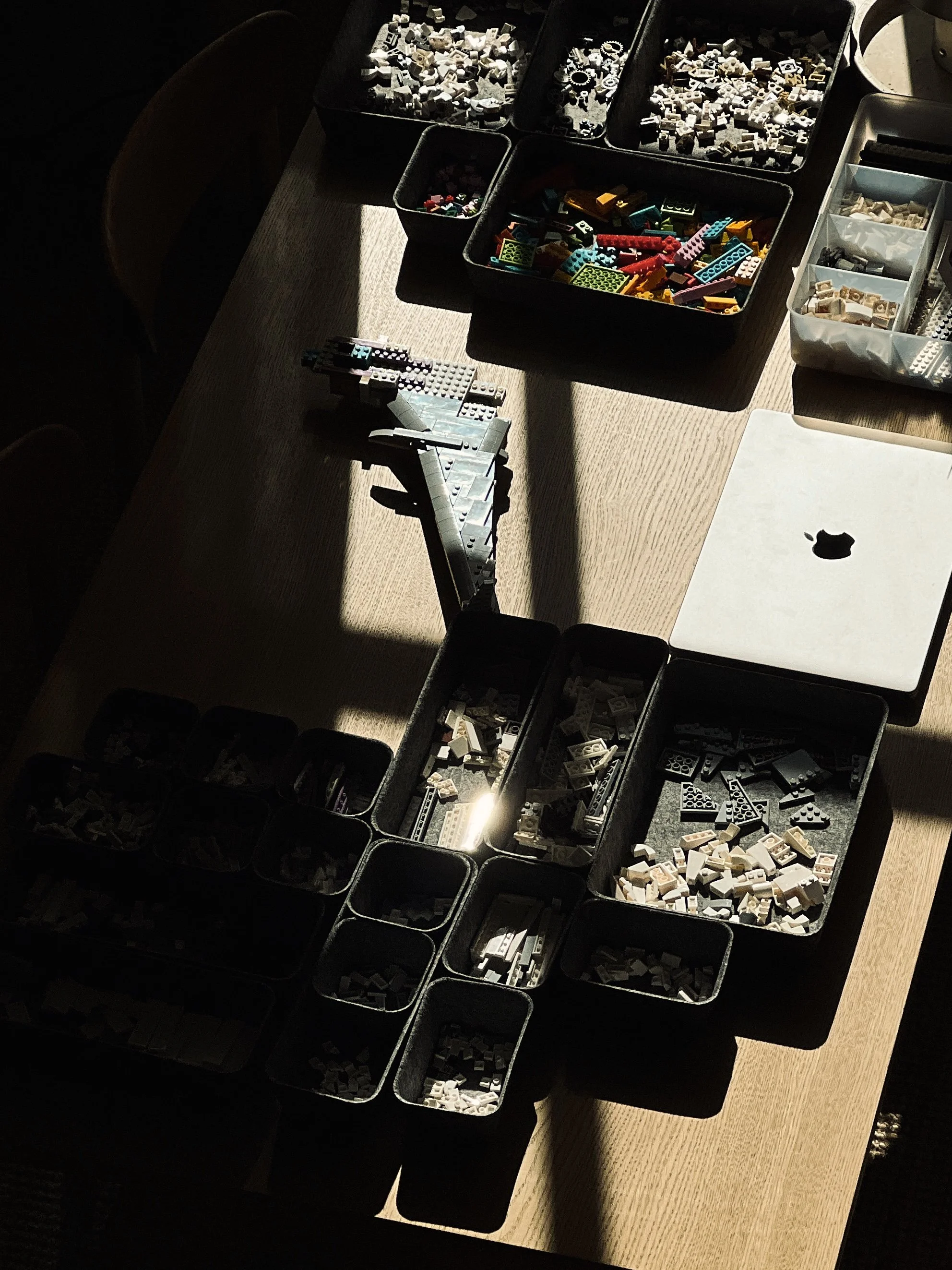
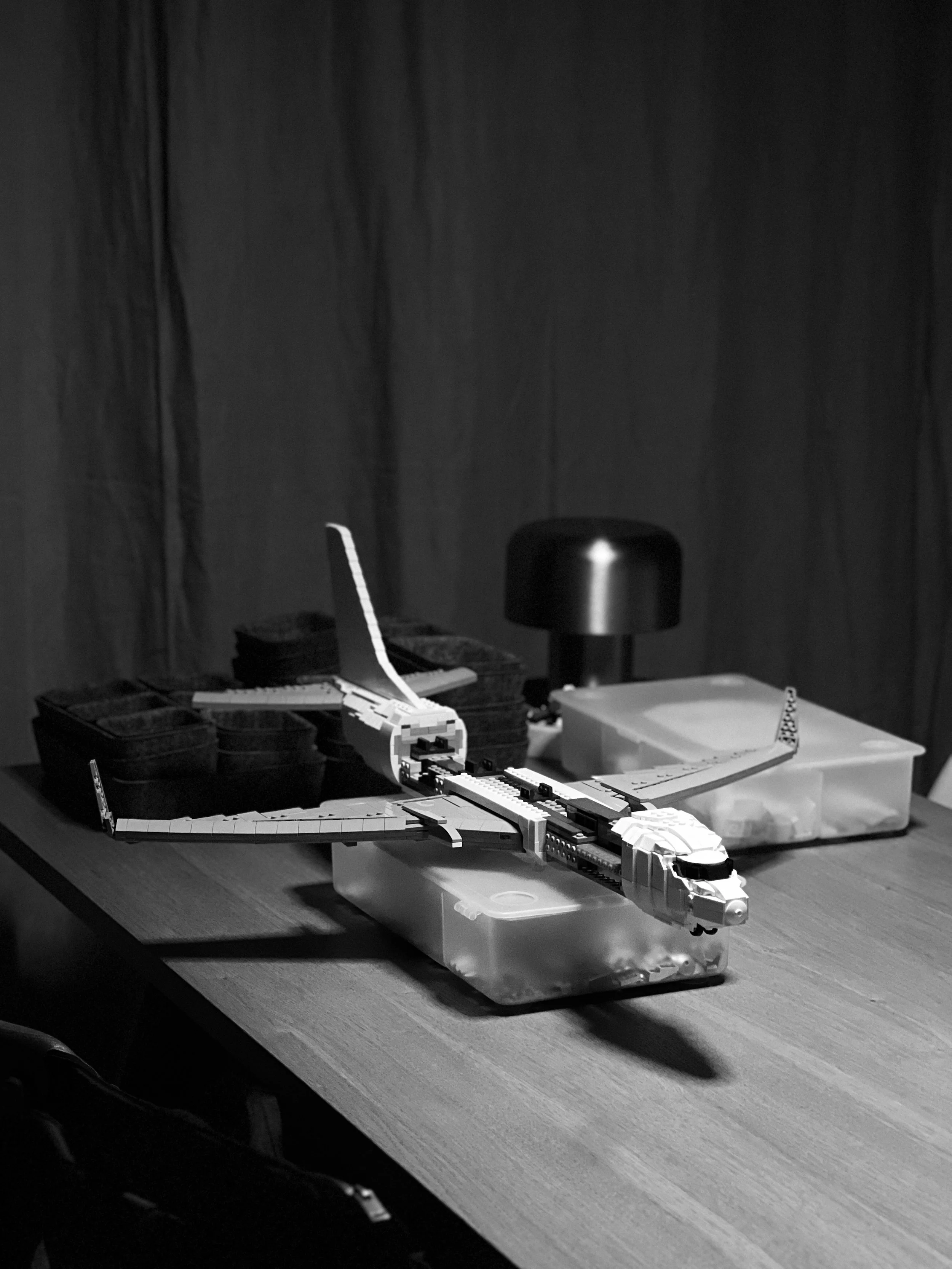
There is considerably more colour among those pieces than the finished aircraft would suggest. Although the exterior is almost entirely white and light bluish grey, hidden parts appear in reds, blues and yellows, a deliberate choice by BespokeLegoDesigns to make sourcing more economical. My instinct would be to quieten the internal palette too. It is admittedly an aesthetic concern with almost no practical consequence, but I have always liked the idea that an object can possess visual integrity even where nobody is looking. Once the fuselage is closed, however, the distinction becomes irrelevant. The colour disappears completely and the exterior assumes the restrained quality that first attracted me to the model.
Form under tension
The digital instructions share that pragmatism. They are clear, economical and assume a degree of familiarity with the medium. The opening stages establish the central fuselage and quickly settle into an absorbing rhythm, the sort of building where an evening seems to contract around you. Then the wings begin, and the mood changes. Broad wedge plates extend outwards from surprisingly modest connections, creating a growing sense of both visual and structural tension. There are functional flaps and some beautifully considered geometry, but during construction the wings feel almost implausibly delicate. At certain moments, one or two studs appear to be negotiating on behalf of an alarming amount of aircraft.
I kept expecting a substantial reinforcement to arrive a few pages later. It never really did. There were several attempts, along with two or three instances of language not normally associated with my building table, but eventually everything held. Seen complete, the logic becomes easier to forgive. The wings possess an extraordinary lightness, broad and thin against the narrow body, and their fragility during construction feels inseparable from their elegance afterwards. A more conservative solution might have been reassuring to build, but it would also have altered the silhouette. BespokeLegoDesigns has chosen proportion over reassurance, and the aircraft is more convincing for it.
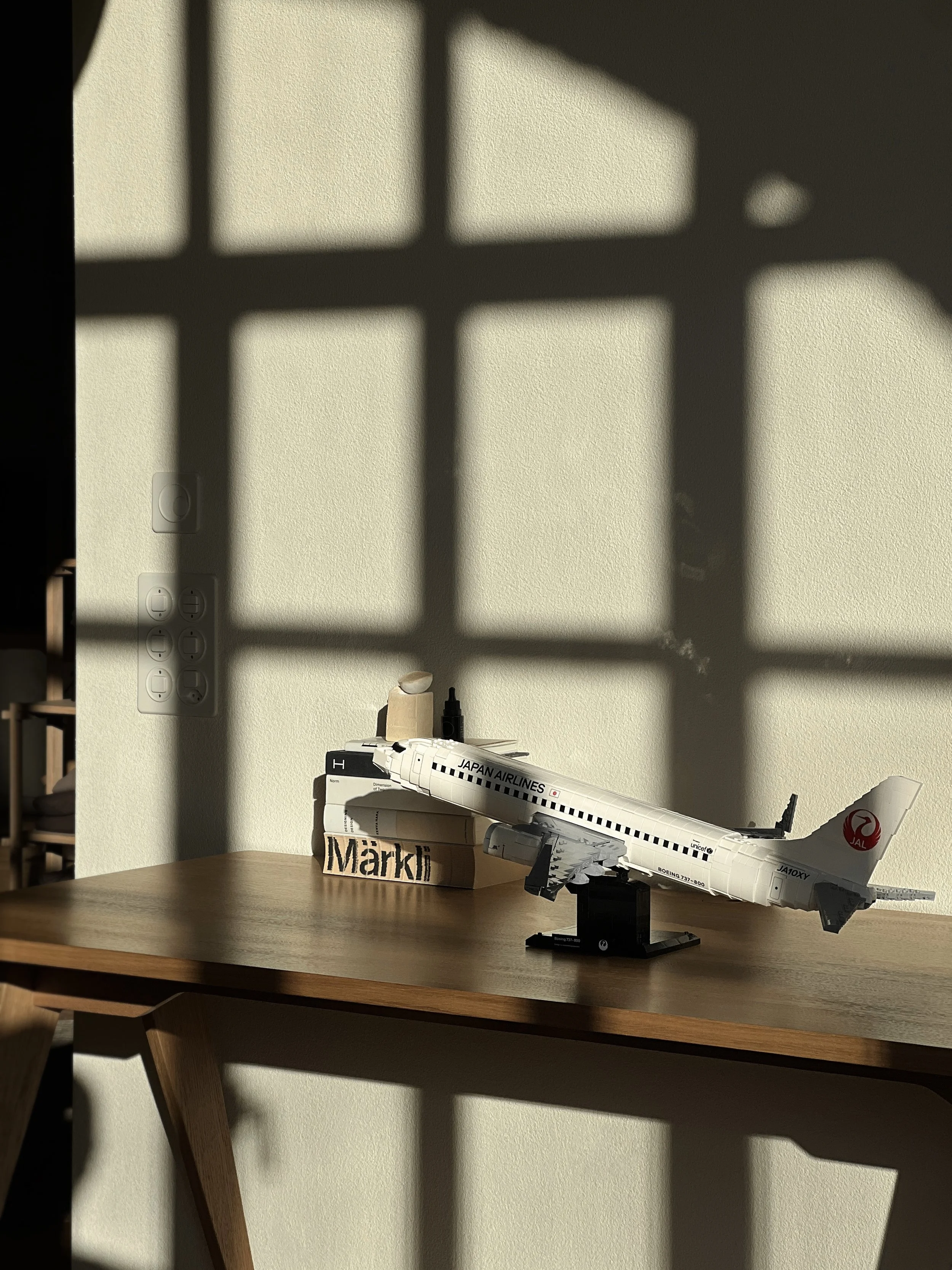
As the fuselage grows, the model begins to reveal another quality that photographs struggle to communicate: its presence. What starts as a manageable object gradually takes possession of the table, giving the characteristic elongation of the 737-800 enough room to register properly. White panels conceal the colourful structure beneath and the visual noise of construction slowly recedes. I particularly enjoyed that transition. There is a moment in many well-resolved objects when the work required to make them begins to disappear, leaving only the intended form behind. Here it happens gradually, section by section.
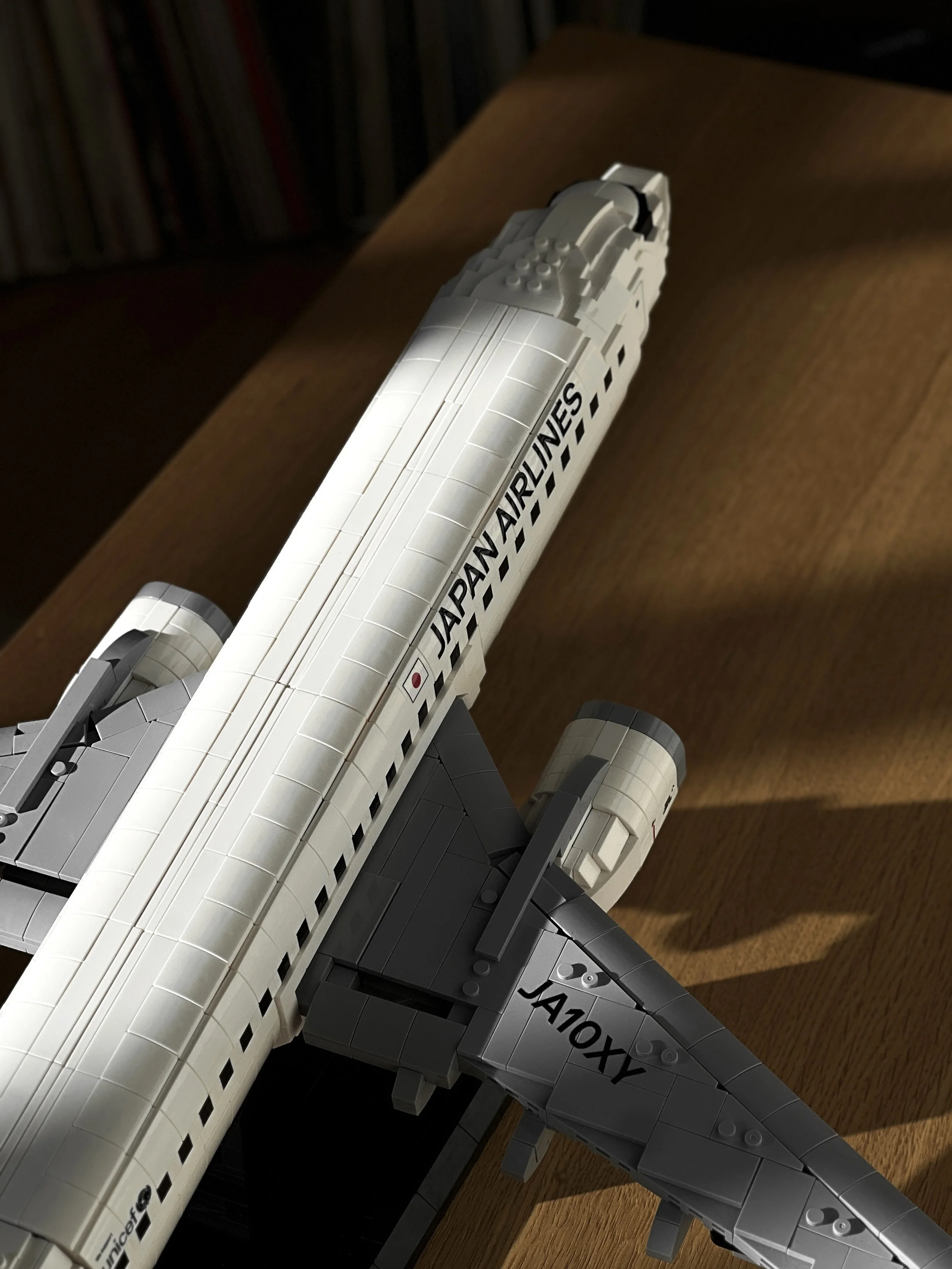
The passenger windows are a particularly satisfying example. Rather than relying on a print or continuous sticker, they are constructed from alternating black and white 1×1 plates mounted sideways into the fuselage. Building them is repetitive, yet the finished line has a precision that makes the process worthwhile. The windows sit within the surface rather than merely upon it, catching small changes in light as you move around the aircraft. From a distance, the individual pieces disappear and become a single dark rhythm, visually extending the fuselage and giving the otherwise white body a sense of scale.
The engines arrive towards the end, using sideways construction to capture the characteristic CFM56 nacelles beneath the low wing. Once attached, the composition seems to settle. The long fuselage, slender wings and comparatively substantial engines find their visual balance, and what had been a collection of techniques becomes convincingly aeronautical. This is where the model is at its best. It does not need to reproduce every curve literally because it understands which relationships matter. Recognition often lives in proportion, rhythm and stance rather than detail, and as someone who spends much of his working life thinking about form and visual communication, I find that considerably more interesting than accuracy for its own sake.
The supplied parts handled the demands of the design well overall, and my set arrived complete, no small achievement across nearly 2,700 elements. A few of the highly stressed connections around the wings would benefit from more consistent clutch, although in the wider context it feels like a modest reservation. Cubertime makes a large and distinctive licensed MOC straightforward to acquire at an accessible price while preserving the character that makes the independent design interesting in the first place. I would personally welcome a premium parts option for builders willing to spend more, particularly for a design that pushes certain elements this hard. By the end of the build, however, individual pieces had largely receded from my attention. I was looking at the aircraft.
Finding its attitude
Display became part of that perception. Resting horizontally, a passenger aircraft can become strangely inert; viewed from standing height, the wings compress into narrow lines and much of their span disappears. I built a simple black plinth that holds the 737 at a gentle climbing angle. The intervention is minimal, but the effect is substantial. The nose lifts, the underside becomes visible and the wings begin to describe space rather than merely occupy it. There is suddenly tension between the mass of the fuselage and the apparent effortlessness of flight. The aircraft feels less like a model placed on a surface and more like a form passing through the room.
The white fuselage presented another kind of opportunity. Working as a creative director, I found an undecorated passenger aircraft almost impossible to leave alone. Few objects demonstrate the relationship between graphic design and three-dimensional form so clearly. Typography follows curvature; a horizontal line can exaggerate or interrupt length; a symbol must retain its identity across radically different viewing distances. On an aircraft, graphic design is not simply applied to an object. It has to negotiate with it.
Japan Airlines became a loose visual reference, less for any individual graphic element than for the restraint and confidence of its identity. I wanted my version to feel plausible and slightly retro-modernist, allowing the architecture of the aircraft to remain dominant. For the typography I chose Riforma by the Zurich design studio NORM, a typeface I had associated with aviation for years without ever having a reason to use it there. Its clarity has an institutional quality without becoming anonymous, and its proportions seemed immediately at home on the fuselage. I drew the graphics as vectors and had them produced as UV-DTF transfers, preserving the sharpness of even the smallest markings against the white surface.
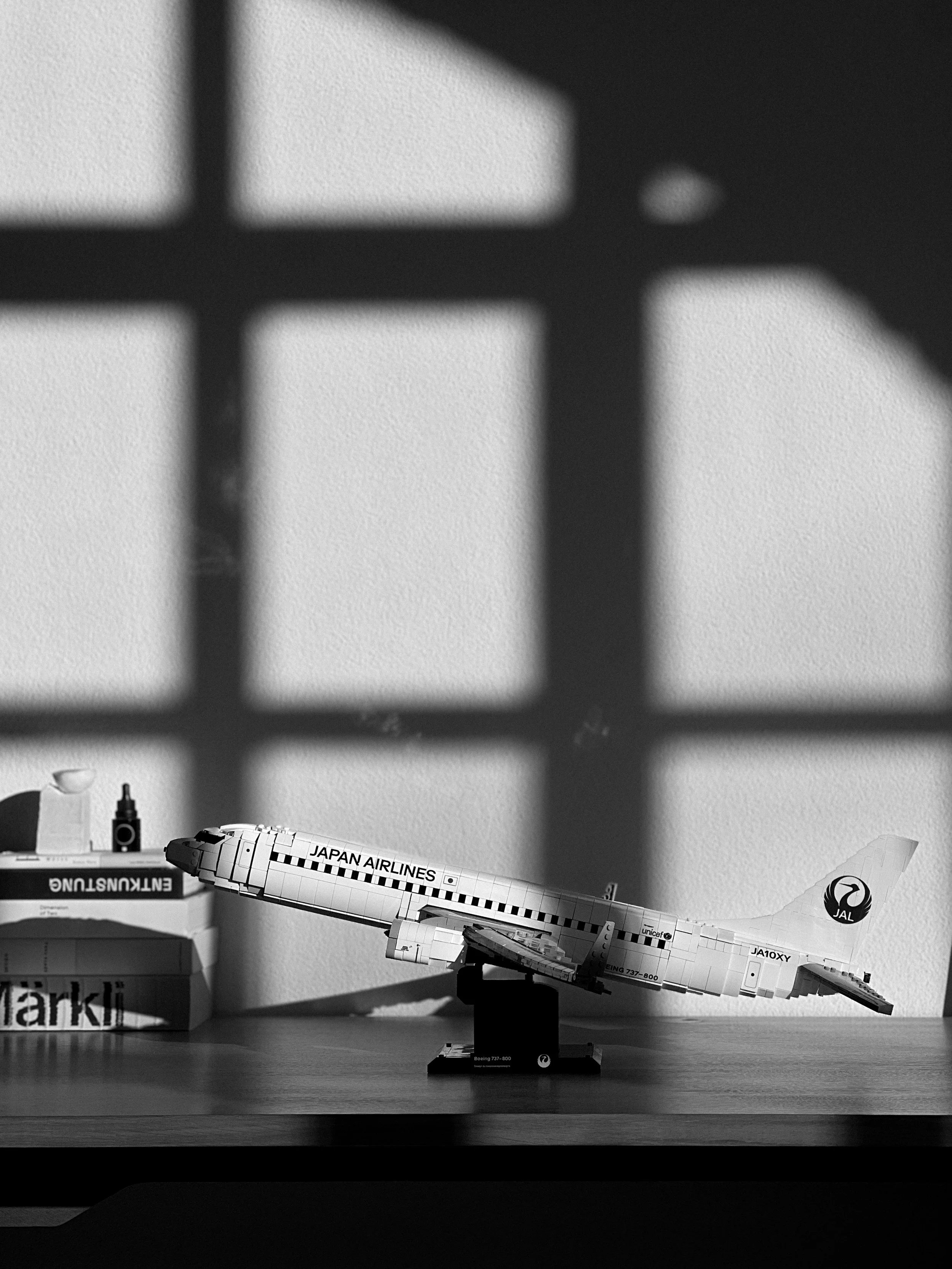
Applying them changed my relationship with the model more than I expected. Until then, I had been following a sequence of other people's decisions: Boeing's original aircraft, BespokeLegoDesigns' interpretation of it and Cubertime's work in turning that interpretation into something tangible and accessible. The stand and livery became my small contribution to that sequence, a way of inhabiting the design rather than simply completing it. From across the room, the individual pieces largely disappeared. What remained was a long white body suspended above two slender wings, punctuated by a quiet line of windows and the visual weight of two engines beneath. Up close, the illusion dissolved again into plates, studs and ingenious approximations of curves. I enjoyed that shift in perception, the object moving back and forth between model and aircraft depending on distance.
Perhaps that is why I spent rather more time looking at the finished 737 than I expected to. The build had been demanding in places, meditative in others, but the lasting impression was emotional as much as technical: the improbable thinness of the wings, the length of the white fuselage, the typography following its surface and the slight upward attitude of the stand. There was something quietly satisfying about having spent so many hours with an object associated, in real life, with considerable unease and finding myself entirely at ease in its company. It had presence without feeling loud, which is a quality I tend to value in objects generally.
Maiden flight
I photographed it one morning, concentrating on those same relationships: profiles, negative space beneath the wings, details of the typography and engines, and finally the wider compositions in which the aircraft seemed almost weightless on its black stand. Satisfied that everything was finished, I went to put it away. About five minutes after the final photograph, the Boeing 737-800 made its maiden flight. It was neither scheduled nor particularly successful. Somewhere between the table and its intended resting place, I lost hold of it, and the aircraft fell from considerable height before meeting the floor with sufficient enthusiasm to answer any remaining questions about the limits of brick-built aviation.
The photographs, at least, had been taken. And for approximately five minutes, I owned a perfectly finished Boeing 737-800.